The First Hour of a Social Media Crisis: A Playbook for CX Teams
A minute-by-minute playbook for the first 60 minutes of a social media complaint wave, from confirming the signal to handing over the incident.
 Nov. 9, 2026
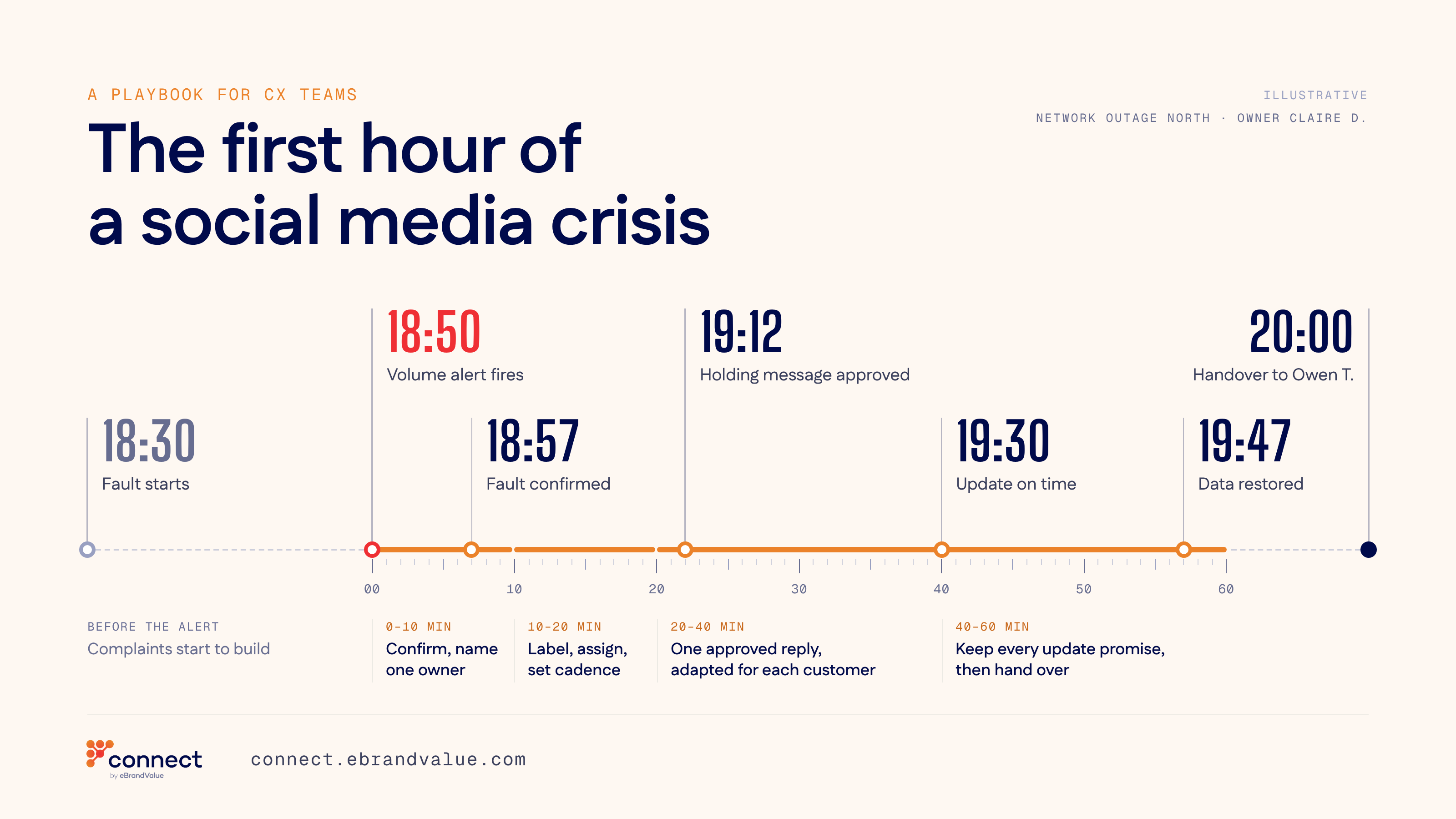
How to confirm the signal, name one owner, group the conversations and keep customers informed in the first 60 minutes of a complaint wave.
Replying to one angry customer is a skill most care agents already have. A complaint wave asks for something different: several hundred replies in the same hour, across five channels, while the facts are still changing. Agents answer from different queues, nobody is sure which wording is approved, and the first public update depends on whoever happens to be free.
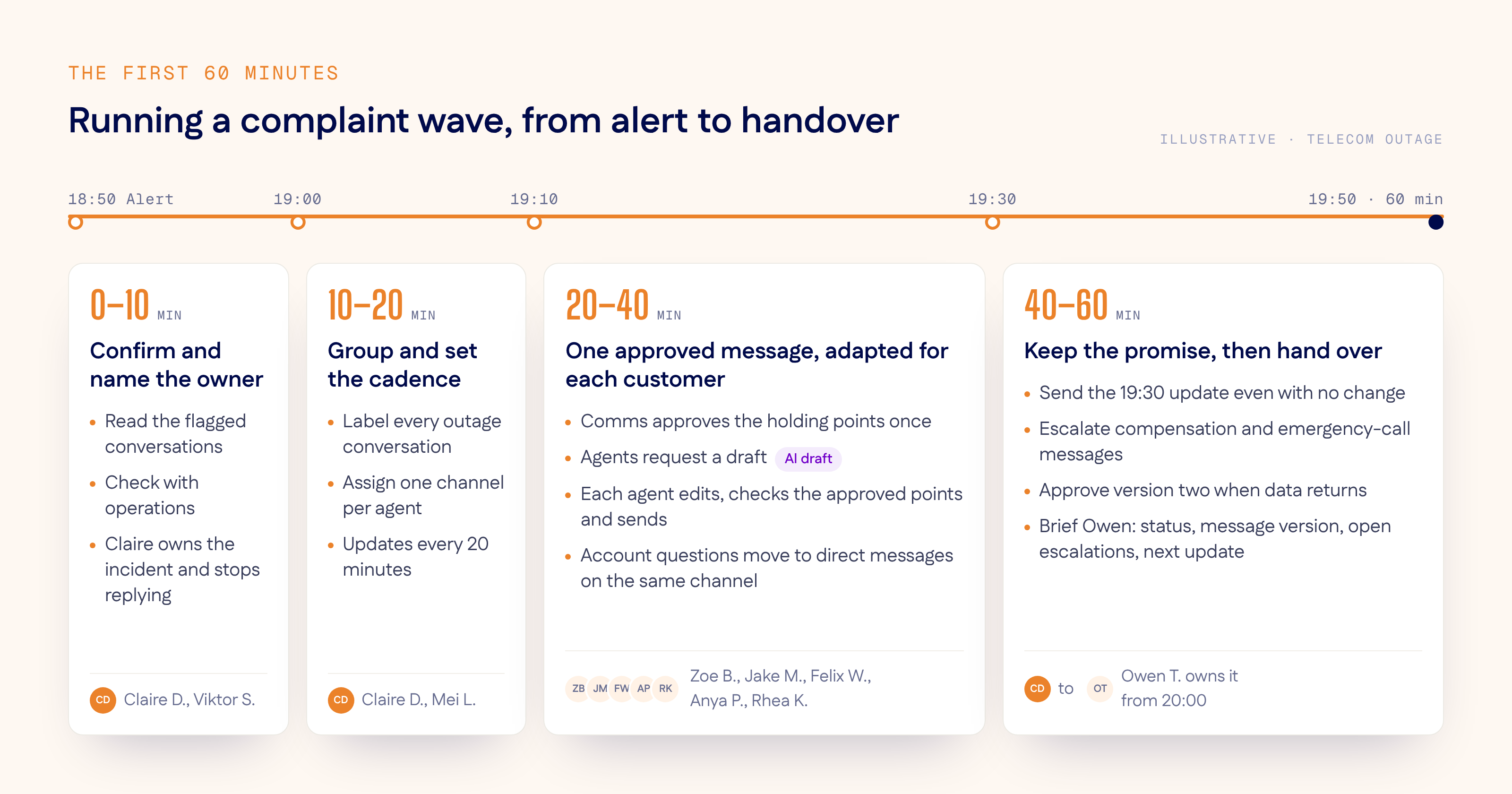
Most of the work in that hour is coordination. The playbook below puts three decisions into the first ten minutes: who owns the incident, how the conversations are grouped and who approves the words. The remaining fifty minutes are spent carrying those decisions out, from the first holding reply to the handover.
Minutes 0 to 10: confirm the signal and name the owner
The example below follows a mobile data outage on a weekday evening. The operator and the people in it are fictional.
Shortly after 18:30 on a Thursday, mobile data stops working for customers in several northern districts. Calls still connect, but apps do not load. Customers post on X, comment under the operator's latest Instagram post, send Facebook and WhatsApp messages and leave one-star reviews in the app stores. At 18:50, the volume alert the team configured months earlier fires and reaches Claire, the team lead, by email and push.
Claire does not reply to anyone yet. She opens the flagged conversations and reads about fifteen of them. They describe the same symptom ("no data", "4G gone", "calls work, internet doesn't"), the same area and a start time shortly after 18:30. She posts in the network operations channel, and Viktor, the operations engineer on duty, confirms an open fault in the region at 18:57. With customer reports and operations in agreement, Claire treats the signal as confirmed.
Claire then names herself incident owner and stops taking conversations. Her message to the team is one line: she owns the incident until handover, and every question about wording, escalation or priority comes to her. This mirrors a principle from emergency management. FEMA's Incident Command System review document defines unity of command as each individual reporting to only one person, and notes that in larger incidents the incident commander "manages the organization and not the incident." It gives one supervisor to five subordinates as a guideline for span of control. Claire has five agents on shift, which sits within that guideline.
Minutes 10 to 20: group the conversations and set the cadence
The outage complaints are mixed in with the evening's usual billing and roaming questions. Claire's first job as owner is to separate them. She filters the inbox for the outage keywords, applies one label, "Network outage North", to every matching conversation and adds a rule that applies the same label to new matches as they arrive. The routine queue waits until later in the evening.
She then assigns the labeled conversations by channel:
| Channel | Agent | Why |
|---|---|---|
| X | Zoe and Jake | Public and fastest-moving |
| Instagram comments | Felix | Public, under the operator's latest post |
| Facebook messages | Anya | Private, often about a specific account |
| WhatsApp and app store reviews | Rhea | Slower-moving, so one agent covers both |
Each agent now has one channel and one topic, and nobody is sorting through a mixed queue to find the next outage message.
Before minute 20, Claire agrees two things with Viktor and with Mei from corporate communications. The first is the update cadence: operations will send a status note every 20 minutes, at 19:10, 19:30 and 19:50, whether or not anything has changed. The second is the escalation path. Questions about the cause or a fix time go to operations. Requests for compensation, contract cancellation or threats to complain to the regulator go to legal through Mei. Any message saying a customer could not reach emergency services goes to Viktor and legal at once and does not receive the standard holding reply.
Minutes 20 to 40: one approved holding reply, adapted for each customer
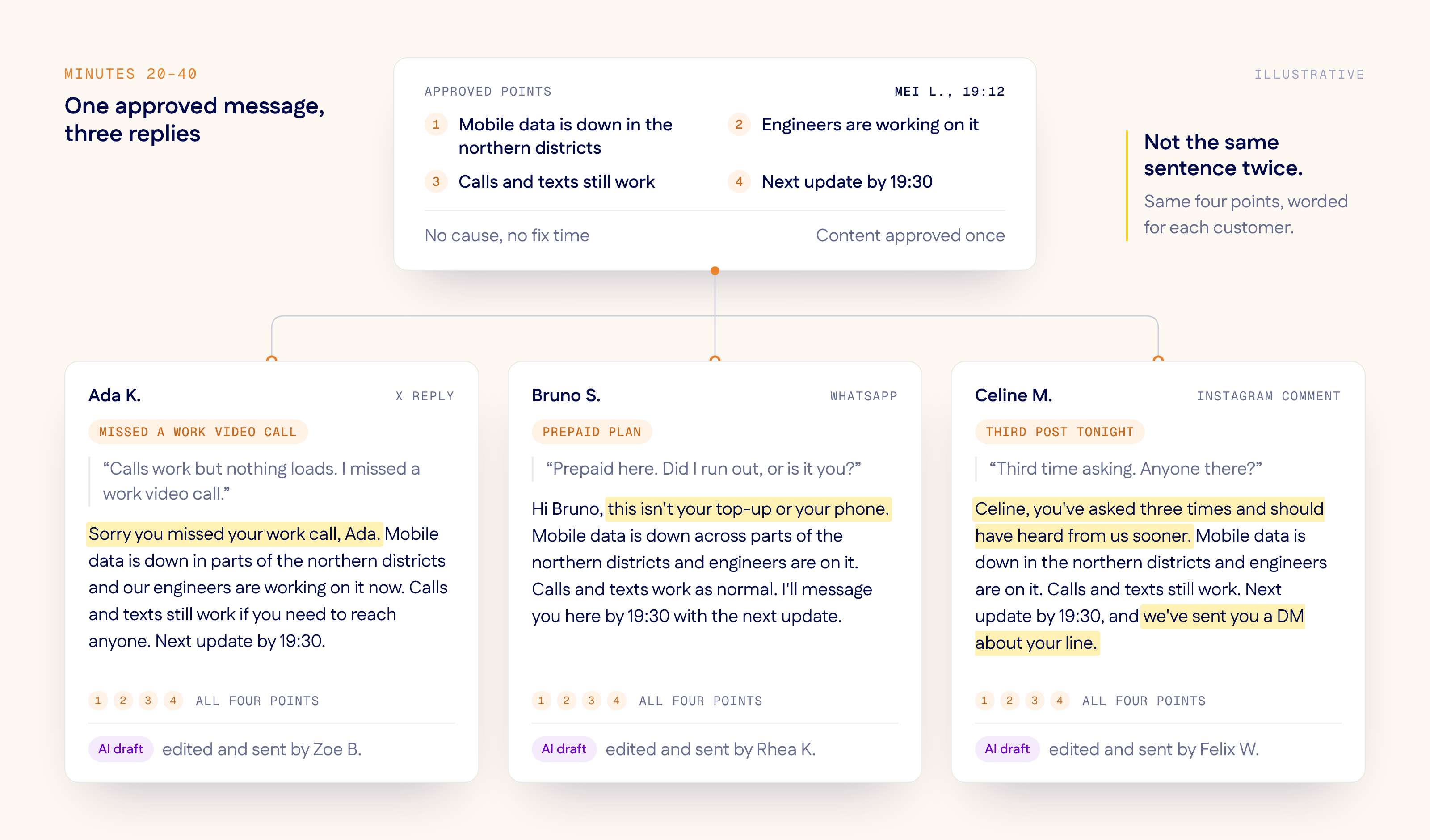
At 19:12, Mei approves a holding message. It confirms that mobile data is down in the named districts, that engineers are working on it, that calls and texts still work and that the next update will come by 19:30. It does not give a cause or a fix time, because operations has not confirmed either.
The team approves the content once and adapts the wording for every customer. A customer who missed a work video call, a customer on a prepaid plan and a customer who has already posted three times should not receive the same sentence. There is a platform rule to keep in mind as well: X's automation rules state that accounts may not post "duplicative or substantially similar posts."
The agents work from the labeled queue in Connect's Unified Workspace, where the collision notice keeps the two X agents from answering the same post twice. For each reply, the agent asks for an AI draft based on the customer's message, checks it against Mei's approved points, edits it and sends it. Account-specific questions move from public comments to direct messages, on the same channel the customer used.
Minutes 40 to 60: keep the promise and avoid the usual mistakes
At 19:30, operations has no new information. Claire still sends the update to the team, and the agents tell customers who are still waiting that engineers are working on the fault and the next update will come by 19:50. Customers who were promised news at 19:30 get a message at 19:30, even though it contains nothing new.
The team has agreed in advance to avoid three habits:
- Deleting or hiding complaints, which removes the record the team needs for the review and does not remove the screenshots customers have already taken.
- Going quiet between updates, which leaves the first reply as the last word customers hear.
- Pasting the same line to everyone, which reads as automated and runs against X's rule on duplicative posts.
At 19:47, Viktor reports that a faulty configuration change was rolled back and data is returning district by district. Mei approves a second version of the message. Because every outage conversation carries the label, the agents can go back to each customer who received the holding reply, rather than waiting for them to post again.
The handover after the first hour
At 19:55, Owen arrives as the night shift lead. The ICS document says that when command transfers, the process includes a briefing that "captures essential information" for continuing operations, and that everyone involved is notified. Claire's handover follows the same logic. She walks Owen through the current status, the approved message version, open conversations by channel, open escalations, the next update time and who is on shift. Owen then confirms in the team channel that he owns the incident from 20:00, so every agent knows who they report to.
The review the next morning depends on what was recorded during the hour. In Connect's Brand Safety & Automation, every alert and automated action is logged next to the rule that triggered it, with a timestamp. The review can set those timestamps next to the team's first response time for the outage conversations, to see how long the first customers waited. Rules can also run within a start and end date, so Claire gives the outage labeling rule an end date after the weekend, and it stops tagging unrelated "no signal" posts once the incident is closed.
The product tour follows a similar spike alert at a bank through to an AI draft that an agent reviews before sending. To see a complaint wave move from the first alert to coordinated replies, follow it in the product tour or rehearse your own first hour in a demo.
Frequently asked questions
What should a customer care team do in the first hour of a social media crisis?
Confirm the signal with a second source, name one incident owner and label and group all related conversations. Agree an approved holding message, an update cadence and an escalation path to communications, legal and operations, then hand over with a written briefing at the end of the hour.
What should a holding statement say during a service outage?
It should confirm what is known, such as the affected service and area, say that the team is working on it and give a time for the next update. It should not guess at the cause or promise a fix time that operations has not confirmed.
Should a brand delete negative comments during a social media crisis?
Deleting or hiding complaints removes the record the team needs for its review, and customers may already have screenshots of the original post. A safer approach is to reply publicly, move account details to direct messages and keep the thread visible.
Who should own a social media crisis on the customer care team?
One named incident owner, usually the shift lead, who stops answering conversations and coordinates the team, the wording and the escalations. Every agent reports to that person until the owner formally hands the incident over to the next shift.
See Connect in action.
Contact us to see how our social and digital customer experience workspace can support your organization.