Social Customer Experience: Why the Same Complaint Arrives on Every Channel
One complaint can arrive through DMs, comments, WhatsApp and reviews. How a care team spots the shared issue, labels it once and gets it fixed.
 Nov. 10, 2026
How care teams spot one issue behind messages in DMs, comments, WhatsApp and reviews, and answer it as one problem instead of many.
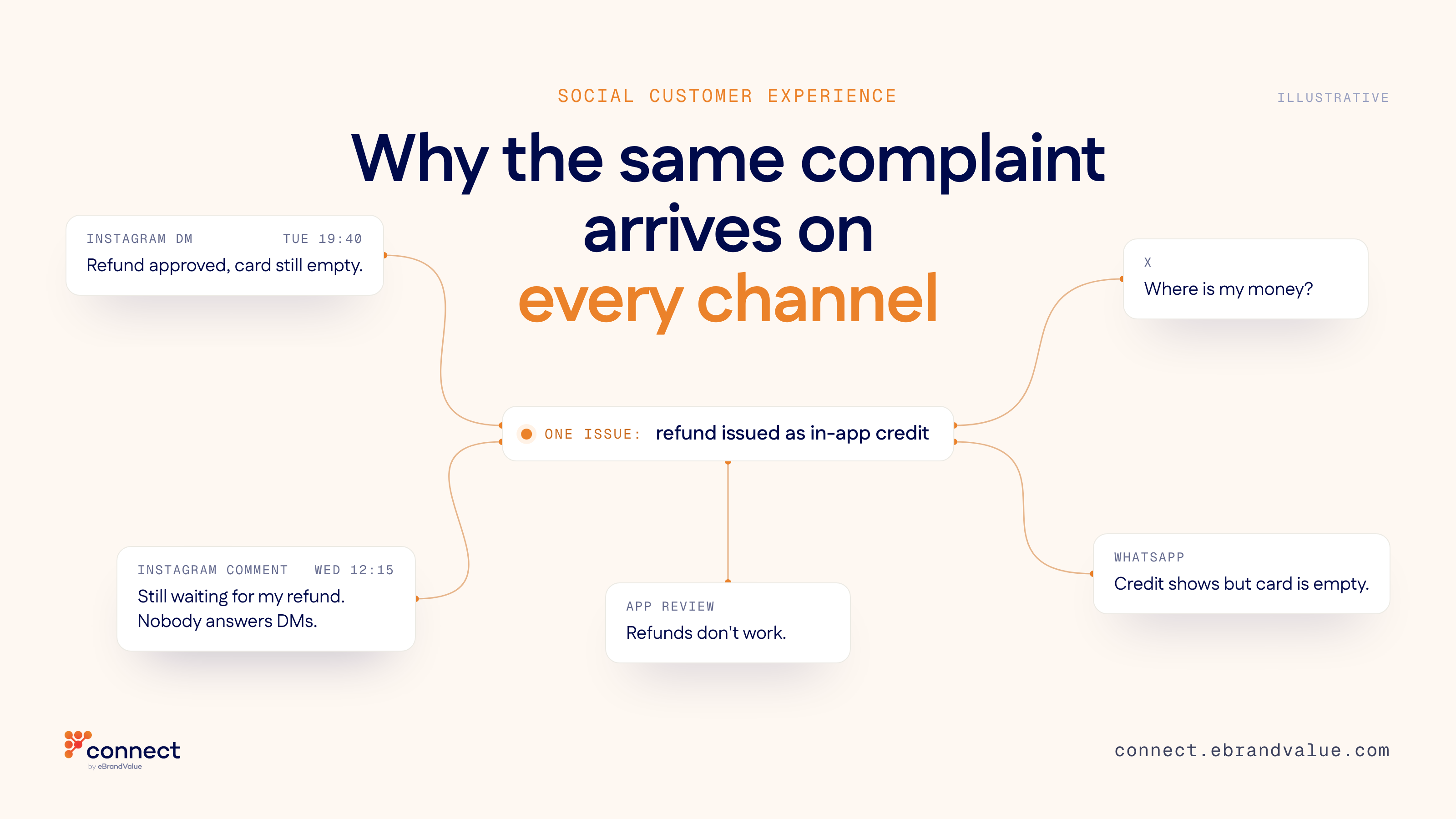
"Where is my money" arrives on X. "Refunds don't work" appears in an app store review. "Credit shows but card is empty" comes in on WhatsApp. Three agents read them, three different labels go on, and each conversation is closed with the refund policy. All three messages describe the same issue: an app update that quietly started issuing refunds as in-app credit.
This is how one complaint usually reaches a care team. Customers send an Instagram DM, reply under the brand's latest post, write on WhatsApp or post on X, and each message arrives as a separate conversation, often handled by a different agent, with its own status and its own history. The customer sees one problem, raised in whichever channel was open at the time. If the first message goes unanswered, some customers try a second channel, and sometimes a third, explaining the issue again each time. A care team can end up answering one issue dozens of times without noticing that it is one issue.
Refund week at a food delivery app
The app, the team and the customers in this example, including the three messages above, are fictional.
On Tuesday at midday, the app releases an update. Among other changes, refunds for missing or incorrect items are now issued as in-app credit by default, instead of back to the customer's card. The confirmation screen mentions it in one short line.
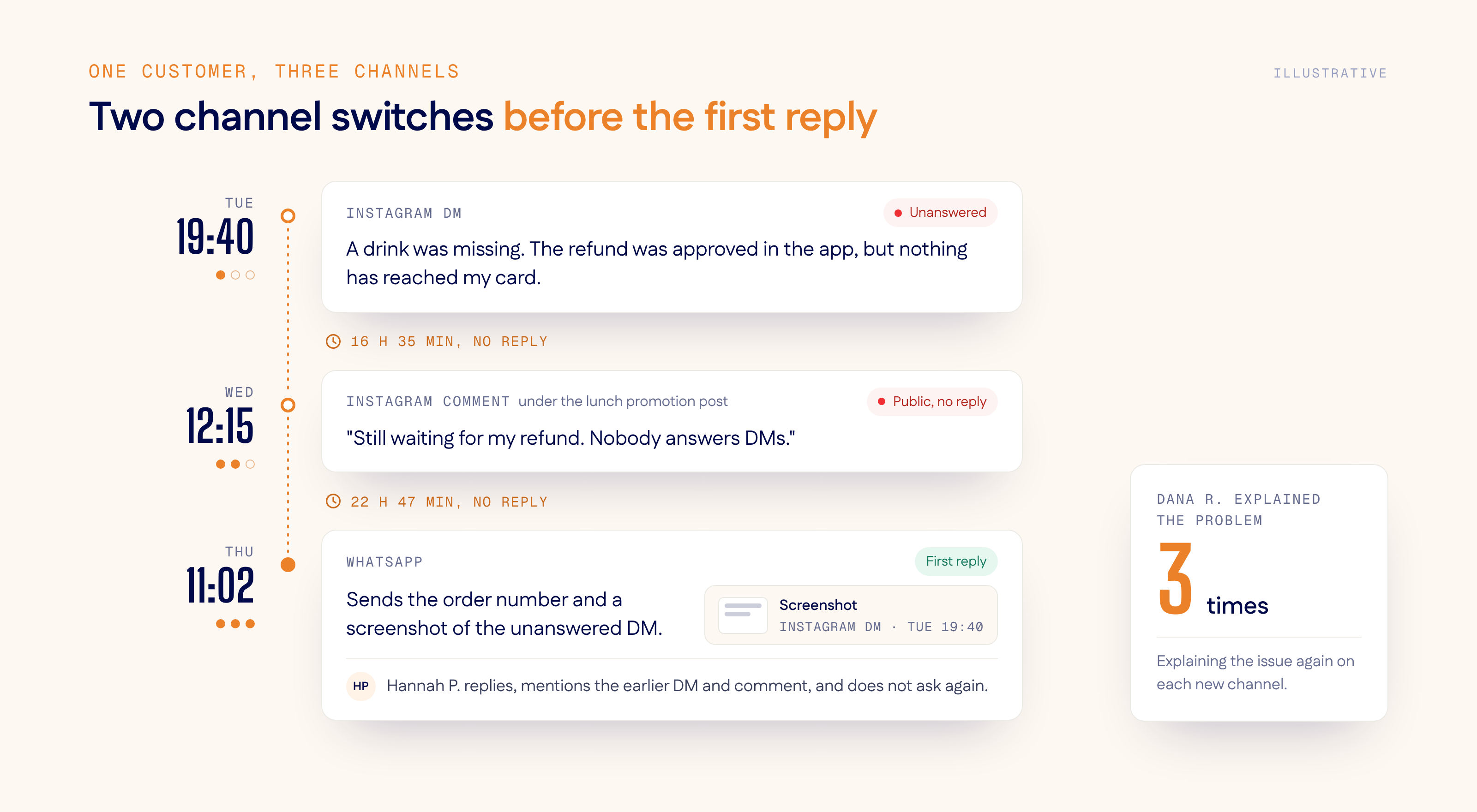
That evening, during the dinner peak, a customer sends an Instagram DM. A drink was missing from the order, the refund was approved in the app, and nothing has reached the card. The DM joins a busy queue and is still unanswered on Wednesday morning. At 12:15, the same customer comments under the app's lunch promotion post: "Still waiting for my refund. Nobody answers DMs." On Thursday, the customer writes on WhatsApp with the order number and a screenshot of the unanswered DM.
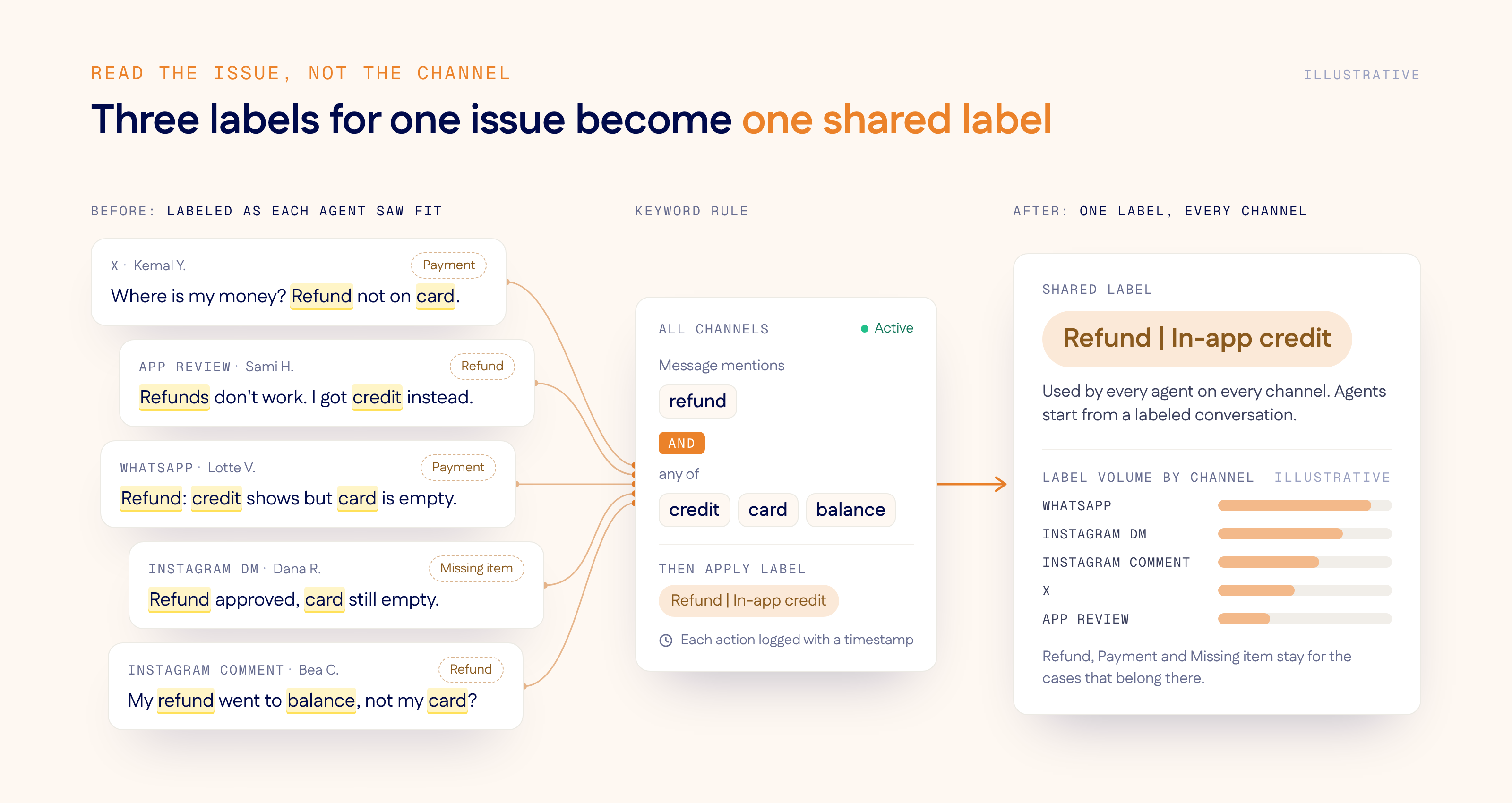
Grace, the team lead, has six agents on the week's shifts. Hannah and a second agent answer WhatsApp, Rosa and a colleague cover Instagram DMs and comments, one agent handles X and another replies to app store reviews. Between Tuesday night and Thursday, all six receive refund messages. The X agent reads "where is my money". The reviews agent reads "refunds don't work". The WhatsApp pair reads "credit shows but card is empty". Each agent replies with the refund policy, labels the conversation as they see fit and closes it. Some labels say Refund, some say Payment, some say Missing item.
Research on customer effort helps explain why the repeat messages matter. In "Stop Trying to Delight Your Customers", published in Harvard Business Review in 2010, Matthew Dixon, Karen Freeman and Nick Toman drew on a study of more than 75,000 people who contacted service representatives or used self-service channels. They found that going above and beyond makes little difference to loyalty, and that what customers want is a simple, quick solution to their problem. Two of the tactics they recommend are reducing repeat calls and minimizing the need for customers to switch service channels. By Thursday, the customer in this scenario had switched channels twice and described the problem three times.
Read the issue, not the channel
On Thursday afternoon, Grace filters the inbox by the keywords "refund" and "credit" across all channels. Side by side, the DMs, comments, WhatsApp messages, X posts and app reviews describe the same thing in different words: refunds arriving as in-app credit that customers do not know about. The underlying issue is a product change, not a payment failure.
Grace makes three changes that afternoon. The first is a single shared label, Refund | In-app credit, used by every agent on every channel. The old Refund, Payment and Missing item labels stay for cases that belong there. The second is a keyword rule that applies the new label automatically when a message mentions refund together with credit, card or balance, so agents start from a labeled conversation instead of deciding each time. In Connect, automation rules can label inbound content when it matches keyword or channel conditions, and every automated action is logged with a timestamp. Which keyword rules are worth setting, and who should hear about them, is the subject of social media alerts that actually help.
The third change is one agreed answer, adapted to each channel. It explains where the credit appears in the app, how to move it back to a card and how long that takes. In private channels the agent includes the steps in full. Under public posts, the reply acknowledges the problem in plain words and invites the customer to continue in a DM, without asking for order numbers in the comment thread. A customer who reads a public reply and later receives a private one hears the same explanation. Agents who use Connect's Reply with AI start from a draft in the brand's voice, then review, edit and send it themselves.
When the customer has already written twice
The customer who wrote three times needs a different reply from a new customer. When Hannah picks up the WhatsApp message on Thursday, she can see from the screenshot that this person has already written on Instagram. Her reply starts there: she acknowledges the earlier DM and the comment, apologizes for the wait and gives the answer without asking the customer to explain again. She then lets Rosa know, so the Instagram DM and the public comment are answered too, each on its own channel, with a short note that the issue is being handled on WhatsApp.
Grace turns that exchange into two team rules. If a customer mentions an earlier message, the agent finds it before replying and does not ask for details the customer has already given. And every conversation the customer opened gets a reply and a status, so the Instagram DM is not left open after the issue is solved on WhatsApp. Both rules assume each conversation has exactly one owner, which is what shared inbox rules for agencies and BPOs sets out.
Connect's Unified Workspace brings DMs, comments, WhatsApp messages and reviews from the connected channels into one inbox, and the Audience pane next to each conversation shows that author's message history. The history is kept per channel handle, so the link between an Instagram account and a WhatsApp number still comes from the agent, usually through an order number, a screenshot or a keyword search.
In this case, the extra contacts started with a slow first reply on Instagram, and the pattern shows up well beyond this example. Across Connect workspaces last month, teams usually picked up a new conversation within minutes, but the customer waited around 70 minutes for the first reply. A customer who hears nothing in that time has every reason to try another channel, and each new attempt arrives in the queue as a separate conversation. That is one reason to track first response time by channel and not only as a single average.
From repeated messages to a fix
By Friday, the shared label has a second use. Because every refund-credit conversation carries it, Grace can send Jonas, who owns the refund flow on the product team, one number instead of a pile of screenshots: 312 conversations in three days, 70% of them on Instagram. She pulls it from the Analytics & Performance Dashboards, filtered by label and channel, compared with the week before and exported. The number carries a specific request: show the refund destination clearly on the confirmation screen and let customers choose card or credit. When the change ships the following week, agents filter by the same label and reply to the customers whose conversations are still open, on the channel each one used, to say that the confirmation screen has changed.
In the product tour, card-decline complaints at a bank arrive on several channels and are labeled, assigned and answered from one inbox. To see how one label pulls the same complaint together from DMs, comments and WhatsApp, take the product tour, or book a demo and bring a complaint your team saw on three channels last week.
Frequently asked questions
What is social customer experience?
Social customer experience is the service customers receive through social and messaging channels such as Instagram DMs, public comments, WhatsApp, Facebook Messenger, X and app store reviews. It covers how quickly they get an answer, whether the answer is consistent across channels and how much effort it takes them to get the problem solved.
Why do customers contact a brand on several channels about the same issue?
A common reason is that the first message did not get a timely answer, so the customer tries another channel, often a public one. Customer effort research recommends reducing repeat contacts and the need to switch channels, because both add effort for the customer. Each new contact also creates a duplicate conversation for the team.
How can a care team tell that messages on different channels are about the same issue?
Use one shared label for each underlying issue across every channel, and apply it with keyword rules where possible. Filtering the inbox by keyword and label across channels shows the pattern, even when customers describe the problem in different words.
Should customer complaints in public comments be moved to DMs?
Acknowledge the complaint publicly first, so other readers see that it was answered. Then invite the customer to continue privately for anything that needs an order number or personal details, and keep the explanation consistent with what the team says in private channels.
See Connect in action.
Contact us to see how our social and digital customer experience workspace can support your organization.