Competitor Mentions: What Your Care Team Hears First
How an airline’s social care team tracks competitor mentions with two labels, a keyword rule and a Friday summary, and what an inbox cannot show.
 Nov. 10, 2026
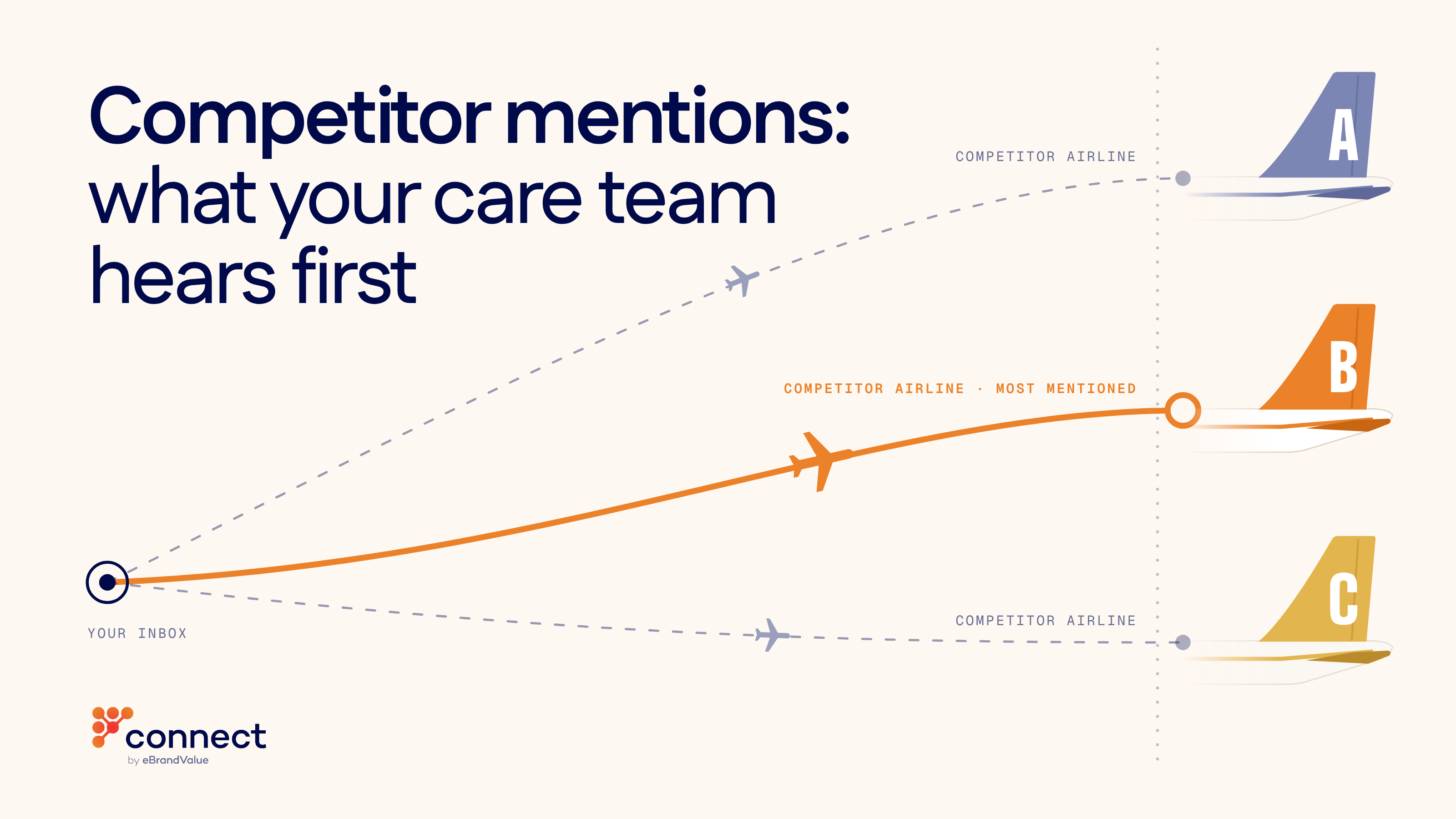
How an airline's social care team records competitor mentions after a frequent flyer program change, and what its inbox cannot show about the market.
"Moving my miles to Competitor B. Ten years in this program and now there's a fee to use them." "Competitor C still lets you book with points on any seat. Why can't you?" A two-star review in the app store: "Award flights used to take three minutes to book here. Now there are no seats and a fee on top. Flying B from now on."
These are competitor mentions: messages in which a customer names or compares a competitor, says they are leaving for one or describes something a competitor already offers. A social care team often reads them weeks before the same names reach a marketing report. With a label, a keyword rule and a short weekly summary, the team can tell marketing and product why some customers are thinking of leaving. It cannot tell them how many are actually moving or to whom, because an inbox only hears from the customers who write. Counting the ones who leave in silence takes market data, which is why this article ends with eBrandValue, Connect's sister product.
A frequent flyer program change at a mid-sized airline
The airline in this example ran into both halves of that problem within a month. It is invented for this article, as are its competitors and its people.
Paula leads social care at a mid-sized airline, and Gavin is her senior agent. On the first Monday of May, the frequent flyer program changes two rules: every award ticket now carries a booking fee, and fewer seats per flight can be booked with miles. Paula plans for fee questions on X, Facebook, Instagram and WhatsApp, and in the airline's app store reviews.
The first week brings the questions she expected: the size of the fee, whether it applies to trips booked in April, why a Saturday flight to Lisbon shows no award seats. In the second week, members start naming other airlines. That Tuesday and Wednesday, Gavin answers four who make the same point in different words: Competitor B lets members pay for part of a fare with miles and the rest in cash, on any seat, while this program only sells fixed award seats. Each conversation gets whichever label the agent thinks fits best, "Loyalty | Award fee" or "Loyalty | Seat availability", and is closed.
On Thursday, Lorna from loyalty marketing sends Paula a short question: "Are we losing members to Competitor B?" Paula knows the name has come up. She cannot say how often, in which kind of message or since when, because the mentions sit under eleven labels and none of them records which airline was named.
Better labels would fix that half of the problem. The other half was described by the economist Albert O. Hirschman in Exit, Voice, and Loyalty (1970). A dissatisfied customer has two options: exit, when they stop buying, and voice, when they express their dissatisfaction directly to the company. Hirschman called exit impersonal and indirect: management learns about it through a set of statistics. Every message Gavin read was voice, and the members who booked their next trip with Competitor B without writing will show up months later, as accounts that stop earning miles.
How to track competitor mentions in three steps
Paula starts with the half she can fix. She and Gavin set up the capture in one afternoon, without changing how agents answer members.
A competitor label on top of the issue label. Each competitor mention keeps its issue label, so "Loyalty | Award fee" still counts as a fee question. The agent adds a competitor label with the airline's name (A, B, C or Other) and a type: leaving, already left, price comparison or feature comparison. The type decides where the message goes next.
A keyword rule for the first pass. In Connect's Brand Safety & Automation, Gavin writes an automation rule that applies the competitor label when a message contains a competitor's name. The rule lists each airline's name, its frequent flyer program, its app and common misspellings. He leaves out two-letter airline codes, which match too many ordinary words, and adds exclusions for known noise, such as a travel deals account that names every program in its weekly roundup. The type stays with the agent, because a keyword match cannot tell "I'm moving to B" from "I'd never fly B again". Every automated action is logged next to the rule that triggered it, so after two weeks Paula can check whether the rule labels the right messages, the same review the team runs on its social media alert rules.
A reply before the record. A competitor mention arrives inside a conversation, and the member is still waiting for an answer. In one month of Connect data, teams usually picked up a new conversation within minutes, but the first reply to the customer took around 70 minutes. A member with Competitor B's booking page open in another tab can buy a ticket in a fraction of that. Paula asks the team to treat "leaving" messages as priority conversations and to track first response time for that label on its own.
| Mention type | Example | Who reads it |
|---|---|---|
| Leaving | "B will match my status. Booking with them from now on." | Care lead and loyalty retention |
| Already left | "Flew Competitor A to Lisbon last month. First time in ten years." | Loyalty marketing |
| Price comparison | "C charges no fee on award tickets." | Loyalty marketing and program pricing |
| Feature comparison | "B lets you pay with miles and cash on any seat." | Program product owner |
Turning competitor mentions into competitive intelligence
With the labels in place, Paula can answer part of Lorna's question every Friday. She sends Lorna and the program's product owner a one-page summary: mentions by competitor and type, the change from the previous week, three messages quoted word for word and what the team replied. She builds it in Analytics & Performance Dashboards, filtering by the competitor labels, reading the period-over-period change in top labels and exporting the charts to Excel.
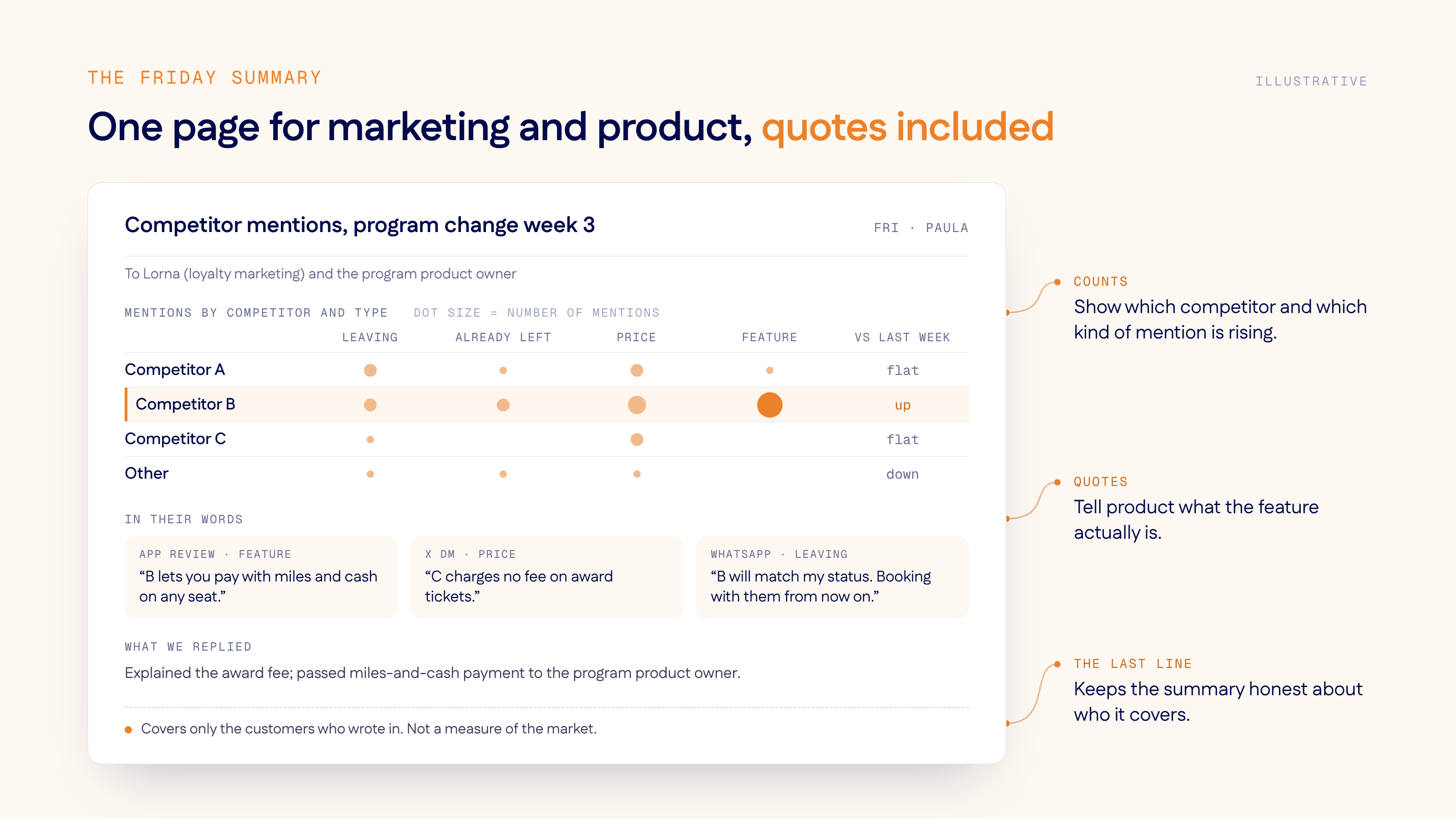
The count tells Lorna that feature comparisons naming Competitor B went up again. The quotes tell the product owner which feature it is: members describe paying with miles and cash as "using what I have", and the current award chart as "waiting for a seat that never opens". By the third week, miles-and-cash payment has an owner on the program side and a line on the agenda of the next planning review.
The award fee was a program decision, so fee comparisons go to Lorna for information only. At the bottom of every summary she keeps one sentence: these figures cover only the members who wrote in, not the market.
What competitor mentions can and cannot tell you
That last sentence draws the line. Competitor mentions are good at the why: which airline members name, what they compare and the words they use. They can also be the first sign of a competitor's offer. When Competitor B starts a status match promotion, members repeat its terms in DMs within days.
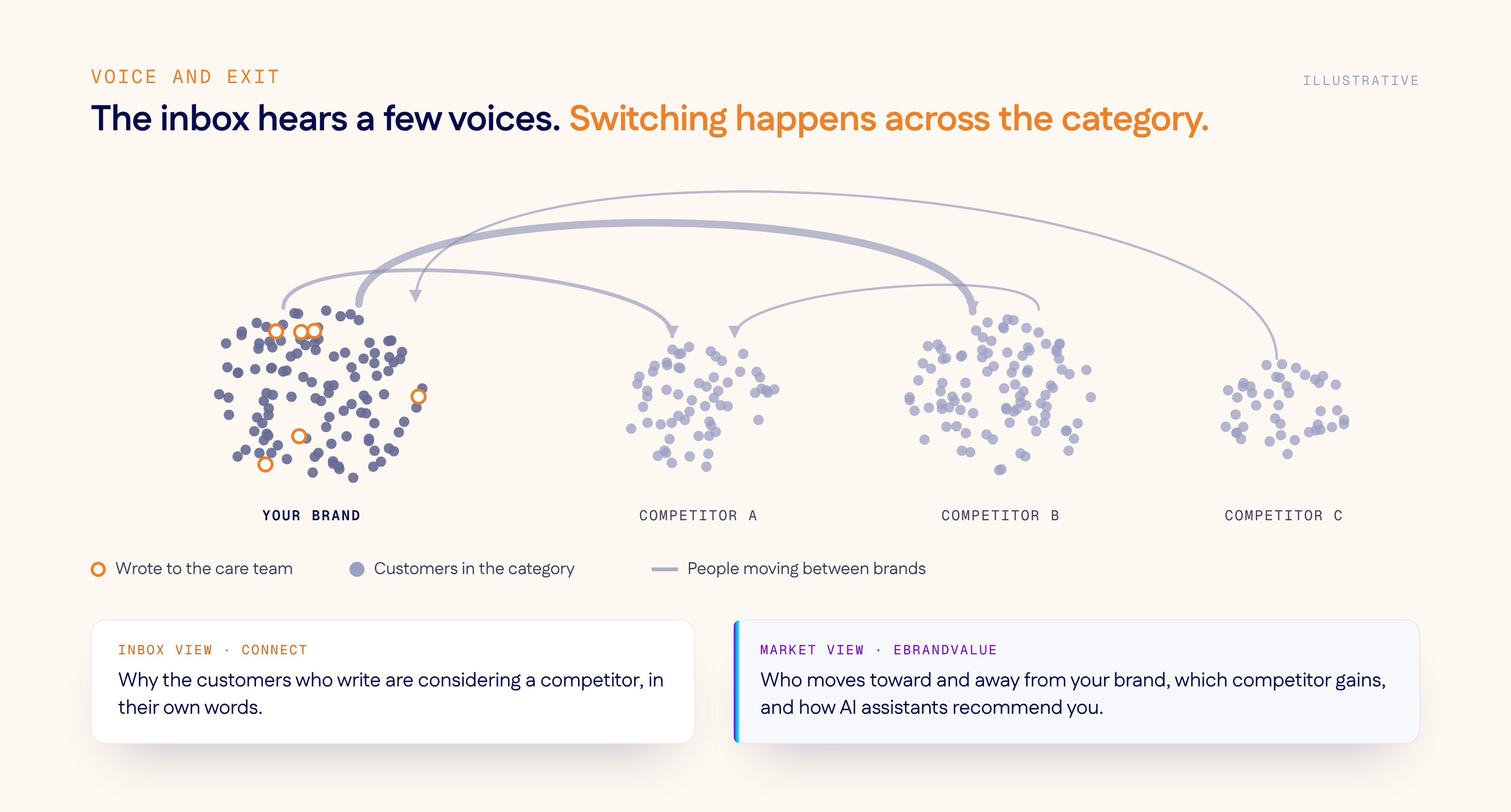
They are weak at the how many. An inbox is a sample of customers who chose voice. A rise in mentions of Competitor B can mean more members are moving their flying to B, or only that the members who write have become more vocal, or that B's campaign has put its name in front of more people. It rarely hears from travelers moving the other way, toward this airline, and it says nothing about what an AI assistant answers when someone asks which frequent flyer program to join.
Connect's Social Listening & Publishing can track competitor brand handles and their performance next to your own. Lorna's question is about people, though: who is moving between the airline and its competitors, and which competitor is gaining.
Beyond the inbox: brand switching with eBrandValue
After three Friday summaries, Lorna comes back with sharper versions of her first question. Is the airline losing members to Competitor B in particular, and since when? Do AI assistants now suggest B when travelers ask which program to join? None of them can be answered from Paula's inbox, because the members who switched without a word never appear in it.
They are market questions, and they are what eBrandValue, the predictive brand intelligence platform whose data engine Connect is built on, was made to answer. Its brand switching analysis follows people on social media whose preferences shift between brands in a category, identifying who moves toward a brand, who moves away and which competitors they choose. eBrandValue's article on how unanswered complaints turn into brand switching starts from a care queue like Paula's and follows those customers into the switching data. AI Mindshare records how AI assistants mention, rank and recommend a brand when someone asks which one to choose.
To see how labels, alert rules and routing work together in one care inbox, take the product tour or book a demo and set up your first competitor labels with us. If Lorna's question sounds like one your own marketing team is asking, explore eBrandValue's competitor and category analytics to measure how many people move between your brand and its competitors.
Frequently asked questions
What are competitor mentions in customer service?
Competitor mentions are messages in which a customer names or compares a competitor: a plan to leave, a lower price, a feature the competitor already offers or a comparison in a review. An airline member writing that another program charges no fee on award tickets is one example. Care teams usually read these messages before anyone else in the company, which makes them an early, qualitative signal for marketing and product.
How do you track competitor mentions in customer conversations?
Add a competitor label with the competitor's name and the type of mention, alongside the existing issue label. Use a keyword rule with competitor names, program or product names, app names and common misspellings to apply the competitor label automatically, and let agents set the type. Send a short weekly summary with counts, changes and verbatim quotes to marketing and product.
Can customer service data show why customers switch to competitors?
It shows why the customers who write to you are considering a switch, in their own words. It cannot show how many customers switch without writing, or how the whole market is moving. That requires a market-level measure such as brand switching analysis.
What is the difference between competitor mentions and brand switching?
Competitor mentions are what individual customers say to your care team about a competitor. Brand switching measures movement across a category: how many people move toward or away from a brand, and which competitors they choose. Mentions give reasons in customers' own words, and switching gives scale and direction.
See Connect in action.
Contact us to see how our social and digital customer experience workspace can support your organization.